We Need Your Support
Donations are tax deductible and you will receive a charitable tax receipt for 100% of your gift.

Act Now

Empower U: Learn to Access Your Disability Rights Training on Canadian Human Rights, the Convention on the Rights of Persons with Disabilities (CRPD) and its Optional Protocol (OP) training aims to increase awareness of how to address discrimination using more familiar Canadian human rights laws such as Human Rights Codes and the newer international Convention on the Rights of Persons with Disabilities (CRPD). This is training for persons with disabilities by persons with disabilities. The training is part of a project funded by Employment and Social Development Canada and implemented by the Council of Canadians with Disabilities (CCD) in collaboration with Canadian Multicultural Disability Centre Inc. (CMDCI), Citizens With Disabilities – Ontario (CWDO), Manitoba League of Persons with Disabilities (MLPD) and National Educational Association of Disabled Students (NEADS). Read more.
Council of Canadians with Disabilities (CCD) and the Canadian Association of the Deaf (CAD) Help Secure Another Major Win for Deaf People
In June 2024, CCD and CAD jointly applied to the Canadian Human Rights Tribunal for interested party status in the case of Lidkea v. Correctional Service of Canada (CSC). The Tribunal granted this request, allowing CCD and CAD to make submissions on the treatment of Deaf inmates within the federal prison system. Our primary focus was on CSC’s duty to provide accommodation to Deaf inmates to remove barriers and ensure that they have the same access to activities, programs and services available to other inmates.
On March 12, 2026, the Tribunal ruled that Mr. Lidkea had been discriminated against by CSC due to its failure to provide sufficient American Sign Language (ASL) interpretation services, as well as other necessary communication accommodations.
The complainant had been incarcerated in multiple institutions over several years. During this time, he was repeatedly unable to communicate effectively with prison staff, program service providers, and other inmates. This significantly impacted his well-being. At the hearing, CSC acknowledged that, although it had attempted to accommodate the complainant, it should have done more. As a result, the key issue before the Tribunal was not whether discrimination had occurred, but rather what remedies should be ordered.
The Tribunal adopted a comprehensive approach to addressing the discrimination and ordered both individual and systemic remedies.
For Mr. Lidkea, the Tribunal ordered CSC to provide ASL interpretation in situations such as:
• Meetings affecting his liberty
• Case management meetings
• Situations requiring informed consent
• Participation in meetings and appointments
• Access to programs and services
• Meetings with legal counsel
• Proceedings before administrative tribunals
• Daily opportunities to communicate with others
• Access to supports and services while on conditional release
In addition, the Tribunal gave CSC twelve months to translate these individual remedies into permanent, systemic policies. CSC was also directed to develop a comprehensive policy on accommodating Deaf inmates, in consultation with the Canadian Human Rights Commission.
The Tribunal’s willingness to order both individual and systemic remedies represents a significant victory for people with disabilities. It also establishes an important legal precedent that will support our future litigation and advocacy efforts.
CCD wishes to thank Connor Bildfel and his colleagues at McCarthy Tétrault for their excellent work in providing CCD and CAD with legal representation before the Tribunal.
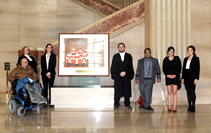
Some members of the CCD team at the Supreme Court of Canada on April 25, 2018 to intervene in S.A. v. Metro Vancouver Housing Corporation. (L. to R. Bob Brown, CCD Human Rights Committee member, Dianne Wintermute, legal counsel (ARCH), Dahlia James, a second year JD candidate at U. of Ottawa and Prof. Ravi Malhotra’s Research Assistant and Luke Reid, legal counsel (ARCH) , and Prof. Ravi Malhotra, a member of the Human Rights Committee, Prof. Anne Levesque, Chair of the Human Rights Committee, and Erin Carr, a second year JD candidate.
The Latimer Case
The Latimer case directly concerned the rights of persons with disabilities. Mr. Latimer's view was that a parent has the right to kill a child with a disability if that parent decides the child's quality of life no longer warrants its continuation. CCD explained to the court and to the public how that view threatens the lives of people with disabilities and is deeply offensive to fundamental constitutional values. Learn more.