We Need Your Support
Donations are tax deductible and you will receive a charitable tax receipt for 100% of your gift.

Act Now

Empower U: Learn to Access Your Disability Rights Training on Canadian Human Rights, the Convention on the Rights of Persons with Disabilities (CRPD) and its Optional Protocol (OP) training aims to increase awareness of how to address discrimination using more familiar Canadian human rights laws such as Human Rights Codes and the newer international Convention on the Rights of Persons with Disabilities (CRPD). This is training for persons with disabilities by persons with disabilities. The training is part of a project funded by Employment and Social Development Canada and implemented by the Council of Canadians with Disabilities (CCD) in collaboration with Canadian Multicultural Disability Centre Inc. (CMDCI), Citizens With Disabilities – Ontario (CWDO), Manitoba League of Persons with Disabilities (MLPD) and National Educational Association of Disabled Students (NEADS). Read more.
Access/Inclusion Archives
Access/Inclusion
November 18, 2025
Nova Scotia League for Equal Opportunities |1 Week Left to Register for In-Person Tickets | Ability to Rise: Celebrating Leaders in Disability Inclusion 2025
Our second annual Ability to Rise: Celebrating Leaders in Disability Inclusion Celebration in recognition of the United Nations’ International Day for Persons with Disabilities is on December 3, 2025 at Cedar Event Centre from 8:30 AM - 4:30 PM. Read more.
October 17, 2025
Weekly Email Digest for Information Sharing Purposes October 14 - October 17, 2025
News from the disability community. Read more.
October 10, 2025
PRESS RELEASE: Arbitrary Relocation of Residents with Developmental Disabilities Due to Labour Dispute Violates Rights and Endangers Safety at Central West Specialized Developmental Services (CWSDS)
Currently, all residents from CWSDS supportive living homes have been arbitrarily moved to one central location at 53 Bond Street in Oakville. “The plan to relocate all residents to one location means residents will be forced to live with strangers. They will lose the ability to take part in their daily activities and community programs that bring them joy, health, and connection.” — Rabia Khedr Read more.
October 9, 2025
Weekly Email Digest for Information Sharing Purposes September 22 - October 6, 2025
News from the disability community. Read more.
October 9, 2025
From 'liability' to leader: Why lived expertise matters to our work for social change
Ingrid Palmer, CCD 1st Vice Chair, shares her career origin story. Read more.
March 17, 2025
Statement on the Passing of Ellen Cohen - Disability Community Mourns Her Loss Issued
It is with profound sadness that we share the news of the sudden passing of Ellen Cohen, a lifelong advocate for the rights and dignity of people with disabilities. Read more.
January 13, 2025
CCD invites you to a Celebration of Life for Laurie Beachell
WHEN: Saturday, February 1, 2025
Zoom formal program: 2:10 pm - 3:10 pm (CST)
In person gathering: 2:00 pm - 4:00 pm (CST)
WHERE: Online: Zoom
In Person: Main floor classroom
Canadian Museum for Human Rights
85 Israel Asper Way, Winnipeg, MB
Read more.
December 7, 2024
Remembering Laurie Beachell
It is with deep sadness that the Council of Canadians with Disabilities (CCD) announces the passing of Laurie Beachell, who died from complications due to pneumonia. As Heather Walkus, CCD’s Chairperson notes, “Canada has lost a remarkable and dedicated champion of disability rights. Laurie served as the National Coordinator of CCD from 1984 to 2015.” Read more.
November 27, 2024
Weekly Email Digest for Information Sharing Purposes November 15 - November 25, 2024
News from the disability community. Read more.
September 6, 2024
Weekly Email Digest for Information Sharing Purposes September 4 - September 6, 2024
News from the disability community. Read more.
July 26, 2024
Weekly Email Digest for Information Sharing Purposes July 24 - July 26, 2024
News from the disability community. Read more.
July 26, 2024
Weekly Email Digest for Information Sharing Purposes July 15 - July 23, 2024
News from the disability community. Read more.
July 15, 2024
Weekly Email Digest for Information Sharing Purposes July 8 - July 12, 2024
News from the disability community. Read more.
July 8, 2024
Weekly Email Digest for Information Sharing Purposes July 1 - July 7, 2024
News from the disability community. Read more.
July 2, 2024
Weekly Email Digest for Information Sharing Purposes June 24 - June 28, 2024
News from the disability community. Read more.
June 21, 2024
Weekly Email Digest for Information Sharing Purposes June 17 - June 21, 2024
News from the disability community. Read more.
June 19, 2024
Weekly Email Digest for Information Sharing Purposes June 10 - June 17, 2024
News from the disability community. Read more.
June 6, 2024
Weekly Email Digest for Information Sharing Purposes May 27 - June 6, 2024
News from the disability community. Read more.
May 26, 2024
Weekly Email Digest for Information Sharing Purposes May 20 - May 24, 2024
News from the disability community. Read more.
May 22, 2024
Gender-based Analysis Plus Quick Resource Guide
GBA Plus benefits organizations, because it supports program/project implementors and researchers, to positively impact as many people as possible who would benefit from the type of support offered. In terms of the Council of Canadians with Disabilities’ work, accessibility is a spectrum, and many folks with disabilities are multi-marginalized and fall in other categories of systemic marginalization; being able to reflect on who is and isn’t being included in a program/project, translates into making sure our services are impacting the most amount of people, in the best way possible.
May 17, 2024
Weekly Email Digest for Information Sharing Purposes May 13 - May 17, 2024
News from the disability community. Read more.
April 24, 2024
BC Pans New Federal Disability Benefit | The small amount and limited eligibility leave people in poverty, says minister.
The benefit for people with disabilities included in last week’s federal budget is too small and will leave too many people out, B.C. Minister of Social Development and Poverty Reduction Sheila Malcolmson said Monday. Read more.
April 22, 2024
Weekly Email Digest for Information Sharing Purposes April 15 - April 19, 2024
News from the disability community. Read more.
April 17, 2024
National disability benefit in federal budget falls short of what advocates wanted
Advocates say the budget commitment doesn't cover enough Canadians and won't lift those it does cover out of poverty. Read more.
March 25, 2024
Weekly Email Digest for Information Sharing Purposes March 11 - March 22, 2024
News from the disability community. Read more.
March 22, 2024
Let the Games Begin!
50th Annual Western Blind Curling Championships Open in Edmonton. Hosted at the Granite Curling Club
March 8, 2024
Too many women still left behind this International Women's Day
"One in three women in Canada still grapples with violence and poverty, underscoring the urgent need for renewed action on this day of celebration.Canada passed the Accessible Canada Act in 2019, with a preamble that notably cautioned against intersecting discrimination. Yet, a year into the provincial and territorial rollout of a National Action Plan to End Gender-Based Violence, the distinct threat to women with disabilities persists without substantial redress, even as they now constitute a significant portion of the population." ~ Bonnie Brayton Read more.
March 8, 2024
Weekly Email Digest for Information Sharing Purposes March 4 - March 8, 2024
News from the disability community. Read more.
March 4, 2024
Weekly Email Digest for Information Sharing Purposes February 26 - March 4, 2024
News from the disability community Read more.
February 26, 2024
Weekly Email Digest for Information Sharing Purposes February 19 - February 26, 2024
News from the disability community. Read more.
February 16, 2024
Weekly Email Digest for Information Sharing Purposes February 12 - February 16, 2024
News from the disability community. Read more.
February 12, 2024
Have Your Say on Community-Based Research
We welcome your suggestions concerning community-based research principles, guidance, and good practices. We want to learn from organizations in the disability community about how they conduct community-based research Read more.
February 12, 2024
Weekly Email Digest for Information Sharing Purposes February 5 - February 9, 2024
News from the disability community. Read more.
February 5, 2024
Weekly Email Digest for Information Sharing Purposes January 22 - February 2, 2024
News from the disability community. Read more.
January 22, 2024
Weekly Email Digest for Information Sharing Purposes January 15 - January 19, 2024
News from the disability community. Read more.
January 15, 2024
Weekly Email Digest for Information Sharing Purposes January 3 - January 12, 2024
News from the disability community Read more.
January 2, 2024
Weekly Email Digest for Information Sharing Purposes December 23, 2023 - January 2, 2024
News from the disability community. Read more.
January 2, 2024
New Year's Greeting 2024
Let us consider starting 2024 with a commitment first to our own personal wellness, second to understanding the incredible strength in caring about and learning from each other and third to enjoying the journey. Let us model the way we want to be treated, in how we work together. Thank you all for the privilege of working together with you and for your individual and collective work every day. Read more.
December 22, 2023
Holiday Seasonal Message from CCD
“May this holiday season be a time of peace, gratitude, and hope.” ~ Ian Young, CCD Secretary Read more.
December 22, 2023
Weekly Email Digest for Information Sharing Purposes December 18 - December 22, 2023
News from the disability community. Read more.
December 15, 2023
Weekly Email Digest for Information Sharing Purposes December 11 - December 15, 2023
News from the disability community. Read more.
December 10, 2023
Weekly Email Digest for Information Sharing Purposes December 4 - December 8, 2023
News from the disability community. Read more.
December 6, 2023
Nearly 3 in 10 Canadians have at least one disability: StatCan
Heather Walkus, CCD Chairperson, shares comments about Statistics Canada's recent data release on disability. Read more.
December 3, 2023
Weekly Email Digest for Information Sharing Purposes November 18 - December 1, 2023
News from the disability community. Read more.
November 17, 2023
Weekly Email Digest for Information Sharing Purposes November 14 - November 17, 2023
News from the disability community. Read more.
November 13, 2023
Weekly Email Digest for Information Sharing Purposes November 4 - November 13, 2023
News from the disability community. Read more.
November 6, 2023
Weekly Email Digest for Information Sharing Purposes October 30 - November 3, 2023
News from the disability community. Read more.
October 30, 2023
Weekly Email Digest for Information Sharing Purposes October 13, 2023
News from the disability community. Read more.
October 30, 2023
Weekly Email Digest for Information Sharing Purposes September 25 - October 13, 2023
News from the disability community. Read more.
October 30, 2023
Weekly Email Digest for Information Sharing Purposes October 20 - October 27, 2023
News from the disability community. Read more.
October 12, 2023
Weekly Email Digest for Information Sharing Purposes September 25 - October 13, 2023
News from the disability community. Read more.
September 22, 2023
Weekly Email Digest for Information Sharing Purposes September 1-22 2023
News from the disability community. Read more.
September 19, 2023
Steven Brien Estey, age 60, of Dartmouth Nova Scotia, passed away at the Dartmouth General Hospital on Monday, September 11th, 2023
Steve took on central roles at the Council of Canadians with Disabilities and Disabled Peoples’ International, a Canadian based NGO. Read more.
August 25, 2023
Weekly Email Digest for Information Sharing Purposes August 21 - 25, 2023
News from the disability community. Read more.
August 22, 2023
Weekly Email Digest for Information Sharing Purposes August 14 - 18, 2023
News from the disability community. Read more.
August 22, 2023
Weekly Email Digest for Information Sharing Purposes August 7 - 11, 2023
News from the disability community. Read more.
August 8, 2023
Increasing Economic Integration for Canadians With Disabilities
An op-ed by Heather Walkus, CCD Chairperson, and Dr. Michael Prince, Lansdowne Professor of Social Policy in the Faculty of Human and Social Development - University of Victoria, has been published in The Future Economy. Read more.
August 4, 2023
Weekly Email Digest for Information Sharing Purposes July 31 - August 4, 2023
News from the disability community. Read more.
August 1, 2023
Weekly Email Digest for Information Sharing Purposes July 18 - July 28, 2023
News from the disability community. Read more.
July 28, 2023
Reporting the sudden passing of Margot Brunner, Executive Director of Voice of Albertans with Disabilities and beloved CCD Council Member
It is with great sadness that April and I are letting you know about the passing of Margot Brunner, the Executive Director of Voice of Albertans with Disabilities (VAD) and member of the CCD Council. Read more.
July 17, 2023
Weekly Email Digest for Information Sharing Purposes July 12 - July 17, 2023
News from the disability community. Read more.
July 7, 2023
Weekly Email Digest for Information Sharing Purposes July 1 - July 7, 2023
News from the disability community. Read more.
July 5, 2023
Job Opportunity The Pathways to Employment Project Job Developer Reports to: Project Manager at NEADS
The National Educational Association of Disabled Students (NEADS) is hiring a Job Developer, as part of its new “Pathways to Employment” project, in partnership with Canada Post and other non-profits in the accessibility sector, including CCD. The project is funded by the federal government's “Workplace Opportunities: Removing Barriers to Equity program”, and focuses on:
- Guiding people with disabilities to move into fulfilling employment.
- Supporting candidates to obtain a wide variety of jobs, ranging from management to semi-skilled manual worker positions.
Identifying opportunities and best practices for accessible employment in the field of postal and courier services.
The project will take an innovative approach to mentor candidates in building skills, capabilities, and accommodations for employment readiness and for their successful transition into employment. Read more.
July 5, 2023
Job Opportunity Sustainable Livelihoods Coach
The National Educational Association of Disabled Students (NEADS) is hiring 8 Sustainable Livelihoods Coaches, as part of its new “Pathways to Employment” project, in partnership with Canada Post and other non-profits in the accessibility sector, including CCD. The project is funded by the federal government's “Workplace Opportunities: Removing Barriers to Equity program”, and focuses on:
- Guiding people with disabilities to move into fulfilling employment.
- Supporting candidates to obtain a wide variety of jobs, ranging from management to semi-skilled manual worker positions.
-
Identifying opportunities and best practices for accessible employment in the field of postal and courier services.
July 4, 2023
Weekly Email Digest for Information Sharing Purposes June 9 - June 30, 2023
News from the disability community. Read more.
June 9, 2023
Weekly Email Digest for Information Sharing Purposes June 5 - June 9, 2023
News from the disability community. Read more.
May 24, 2023
Weekly Email Digest for Information Sharing Purposes May 15 - May 19, 2023
News from the disability community. Read more.
May 16, 2023
Weekly Email Digest for Information Sharing Purposes May 8 to May 12 2023
News for the disability community. Read more.
May 3, 2023
Weekly Email Digest for Information Sharing Purposes April 24 - April 28, 2023
News from the disability community. Read more.
December 22, 2022
Seasonal Greetings
To Council Members, Friends and Allies of CCD:
“I want to congratulate and thank all of you, for your time, commitment, respect and compassion this past year. Your tremendous work with people in our respected communities and your willingness to stretch to also give time to the collective work of CCD, is much appreciated by all of us. As a volunteer organization heading into its 47th year, we collectively have been the home for many for nearly 5 decades.
In June of this year at our AGM, the Qulliq was lit by elder, Mary-Lee Anayok, Nunavummi Disabilities Makinnasuaqtiit Society. https://youtu.be/bJlf52M9SrQ That light gives us warmth and strength and it continues every day to burn softly, continuously, and steadily in our hearts as we work together. This has reaffirmed for all of us, that we continue to be, present, dedicated, respectful, and will continue to do the work together, in defending the Human Rights and Social Justice of the people in our intersectional, cross disability and Deaf communities.
We will continue to do this through our ever emerging knowledge and understanding of each other’s experience and we will continue to do this with our developing principles of Respect, Intersectionality, Sustainability. We will continue the work around our Council Fire, with open hands and hearts, with no weapons and create a safer place for all of us to discuss and work through our many understandings and ways to support our communities.
Many people have found their way to this light this year and we thank all of them who are supporting CCD and giving of their time and welcoming us and opening opportunities for our involvement. Thank you to our Elders Council who are giving their wisdom, generational knowledge and caring spirits to help guide us.
It is an honour to serve you and our work at CCD. I am looking forward to more laughter, caring, sharing and growing understandings in the New Year.”
Heather Walkus
National Chair, CCD
Read more.
December 18, 2021
Season's Greetings and Happy New Year!
“If you want to go fast go alone; if you want to go far go together. Now, at CCD we are moving together and we are going to go far in our efforts to create an equitable, accessible and inclusive Canada created by the many voices and viewpoints of our intersectional community. I want to thank everyone involved in CCD for their hard work this year and I look forward to going far with you in 2022 and beyond. Happy Holidays to everyone.” ~ Heather Walkus, Acting Chair, 1st Vice Chair.
"Thank you for everything you do nationally and in your home province. I look forward to connecting with you on our Governance work over the coming year to build up CCD's effectiveness. May this season and the year to come bring you the best.” ~ Tracy Odell, 2nd Vice-Chair.
“It is the holiday season and the dawn of a new year, a new year can bring new changes and new ideas, on behalf of myself, and the Executive Committee of the Council of Canadians with Disabilities, we extend happiness and peace throughout this season and all year round.
Thank you to the staff, the member organizations, and the strong citizens living with disabilities for continued support and input. You are very valued.
As one, we are a voice, as two, we are a concern, as a group, we become an action.
Happy Holidays!” ~ Ian Young, Secretary.
Pat Danforth has visions of not sugarplums but debits and credits. She is very busy balancing our books but she takes time off from that task to say,
“Wishing everyone a happy holiday season and all the best in the New Year,” ~ Pat Danforth, Treasurer.
“As the holidays approach, may the magic of the holiday season fill your home with joy and peace. Best wishes for happy holidays and a magnificent New Year. Take care of yourselves and stay safe,” Frank Folino, Member-at-Large on Executive Committee. Read more.
December 14, 2021
CCD: Rebuilding Our Capacity to Be a Voice for Disability Rights
The Executive and Council of CCD has, since June 2020, worked on modernizing our policies, practices and systems, as well as strengthening our ability to play a meaningful, strategic and convening role as a human rights advocacy organization in the disability community. We have new work groups, committees and volunteers who are picking up the workload on finances, human resources, technology, and governance. Our human rights, social policy, international and transportation teams continue their work. Read more.
November 26, 2021
Council of Canadians with Disabilities Welcomes New Member-at-Large
The Council of Canadians with Disabilities (CCD) welcomes Ingrid Palmer as a Member-at-Large to our National Council of Representatives. “Ingrid brings a wealth of experience and knowledge from the disability community,” states Heather Walkus, Acting Chair. Read more.
November 25, 2021
Council of Canadians with Disabilities Announces Departure of Chair
The Council of Canadians with Disabilities (CCD) announces the departure of National Council of Representatives Chairperson, Roxana Jahani Aval, who the Council elected in 2020. Ms. Jahani Aval, who is a 3rd year law student, resigned as Chairperson in October. The National Educational Association of Students with Disabilities (NEADS) had appointed Ms. Jahani Aval as their representative to CCD.“CCD thanks Ms. Jahani Aval for her leadership on intersectionality, her service and dedication to CCD and her continuing contribution to disability rights in Canada,” states Heather Walkus. Read more.
November 24, 2021
CCD Echoes Governor General's Call to Listen to Diverse Voices Who Shape Canada
On November 23, 2021, Governor General Mary Simon, the first Indigenous woman to hold this position, read the Speech from the Throne, providing a summary of the Liberal Government’s plans for the First Session of the 44th Parliament of Canada. “Her Excellency Mary Simon called upon Members of Parliament to ‘Listen to the diverse voices who speak a multitude of languages and who shape this country,’ and the Council of Canadians with Disabilities (CCD), a national nonpartisan human rights organization of people with disabilities working for an accessible and inclusive Canada, echoes her call,” states Heather Walkus, CCD Acting Chair. “The Throne Speech addressed the concerns of Indigenous People, Canadian families, racialized people, people affected by climate changes, among others; people with disabilities are part of all these sectors. In the coming weeks, CCD will be monitoring and speaking out about how well this Government is using a disability lens, which it has promised to do, as it works to build a resilient economy and a cleaner and healthier future.” Read more.
August 10, 2021
System Navigator Service Project Seeks Members for Community Working Group
Council of Canadians with Disabilities is seeking up to two Indigenous Peoples of Canada with experiential knowledge of disability to participate in a Community Working Group for its System Navigator Service Project. The Community Working Group meets via Zoom on the last Monday of each month from 9 a.m. to 10:30 a.m. Pacific Standard Time. The monthly meetings will run for the duration of the project, ending in June 2022. Read more.
July 27, 2021
Disability Hall of Fame Honours Human Rights Advocate Frank Folino
Frank Folino is one of the newest members of the Canadian Disability Hall of Fame. Read more.
July 6, 2021
The National Coalition of People Who Use Guide and Service Dogs in Canada | National Standards Threaten the Rights of Canadian Guide Dog Handlers: A Call to Action Issued by the National Coalition of People Who Use Guide and Service Dogs (HOOH) and its Al
The Coalition recently learned that the issue of national standards is once again on the table and once again has the potential to threaten the rights of guide dog handlers. And so once again, the Coalition intends to vigorously protest such standards in so far as they may apply to guide dog handlers. Below, we explain our reasons for objecting to national standards and call on our supporters to take action. Read more.
July 6, 2021
EVIANCE AND COMMUNITY PARTNERS RECEIVE GOVERNMENT FUNDING TO LAUNCH NATIONAL RESEARCH PROJET TO ADVANCE SUSTAINABLE DEVELOPMENT GOALS
The Canadian Centre on Disability Studies Incorporated, operating as Eviance, is pleased to announce we are recipients of funding from the Government of Canada’s Sustainable Development Goals Program, totalling $870,000 over 35 months. Together with community partners, the Council of Canadians with Disabilities (CCD), National Educational Association of Disabled Students (NEADS), ARCH Disability Law Centre, OCAD University, Ryerson University and St. Francis Xavier University, this national project will focus on closing knowledge and skill gaps in Canada regarding inclusive approaches to universal design for learning, instructional excellence, and student support with the goal of furthering the success of diverse students with disabilities in post-secondary education and decent work. Read more.
May 31, 2021
During National AccessAbility Week Commit to Do Your Part to Leave No One Behind
The Council of Canadians with Disabilities (CCD), a national human rights organization of people with disabilities working for an accessible and inclusive Canada, challenges everyone living in Canada to commemorate National AccessAbility Week (May 30 – June 5, 2021) by making a commitment to do their part to ensure that no one is left behind in Canada due to accessibility barriers. Read more.
April 20, 2021
The Wait Continues for a National Disability Benefit, CCD States after Release of Budget 2021
“It is good news the national disability benefit has not fallen off the Government’s radar as people with disabilities face a disproportionate level of poverty,” states Jewelles Smith, CCD Communications & Government Relations Coordinator. “However, our community often feels that we are in an endless consultation loop so we would have liked Minister Freeland to make a commitment on when the benefit is to be up and running.” “We always seem to be a community in waiting,” added Smith. Read more.
November 7, 2020
Nothing About Us Without Us - Council of Canadians with Disabilities (CCD) Looking Forward to Working on Disability Commitments in Throne Speech
The Council of Canadians with Disabilities (CCD) finds that the Liberal Government used a disability lens when developing its national work plan outlined in the September 23rd Throne Speech, including measures to address some of the concerns of people with disabilities. Read more.
April 9, 2019
Support for Disability Organizations Demonstrates Federal Progress on CRPD Implementation
The Council of Canadians with Disabilities (CCD), a national organization of people with various disabilities working for an inclusive and accessible Canada, applauds the April 5th announcement by the Hon. Carla Qualtrough, Canada’s Accessibility Minister, that 28 disability organizations are receiving operational funding in support of their work on social inclusion. Read more.
March 20, 2019
"Budget 2019 - Canadians with disabilities not left out," says Council of Canadians with Disabilities (CCD)
Budget 2019 is not only an investment in the middle class. The disability announcements are also a down payment on the implementation of the international standards that Canada committed to meet when it ratified the UN Convention on the Rights of Persons with Disabilities in 2010. Read more.
January 24, 2018
Not Much Real Change Coming to Canada Post Service
January 24, 2018 - Today, the Government of Canada announced that more neighborhoods will not be converted to community mailbox service, which is a win; but the loss is that existing community mailbox service continues. The losers are the people in those neighborhoods – seniors and people with disabilities – who will continue to have problems independently retrieving their mail, due to the all too well known barriers in the community-mailbox model: snow, sidewalk conditions, etc. People with disabilities and seniors in neighborhoods with community mailboxes continue to depend on other people to get their mail, which negatively affects their independence and privacy. This is not CCD’s vision of an accessible and inclusive Canada.
February 14, 2017
COLLABORATION: THE KEY TO ACCESS AND INCLUSION
CCD is interested in developing an ongoing collaborative working relationship with Parks Canada that will support increased access and inclusion in all of Parks Canada's activities. Read more.
December 17, 2016
Standing Committee's Report The Way Forward for Canada Post Contains Some Backward Elements
The Standing Committee on Government Operations and Estimates released its report The Way Forward for Canada Post, which contains 45 recommendations. Read more.
November 25, 2016
CCD Disappointed by Electoral Reform Bill C-33
While the Council of Canadians with Disabilities (CCD) is pleased with some aspects of the Government's electoral reform bill, "This Bill fails to respond to most of the important amendments to the Canada Elections Act that CCD proposed," said John Rae, 1st Vice Chair of CCD. Read more.
March 23, 2016
Trudeau Government Headed in the Right Direction with Budget 2016
Throughout the life of this government, CCD will be advancing measures, such as the refundable DTC, designed to improve the social and economic conditions of people with disabilities, particularly women and girls with disabilities and others facing multiple forms of discrimination. Read more.
March 1, 2016
REPORT OF SPECIAL JOINT COMMITTEE ON PHYSICIAN-ASSISTED DYING DISCRIMINATES AGAINST BLIND CANADIANS
When the report, "Medical Assistance in Dying: A Patient-Centred Approach" was released last week, “I was anxious to read it, as CCD has been very active in this issue,” says John Rae, Second Vice Chair of the Council of Canadians with Disabilities. “But, to my surprise, it was released only in an inaccessible PDF version that I could not read, and this discriminates against me and all Canadians who cannot read conventional print,” added Rae. Read more.
September 30, 2015
Voting at an Elections Canada Office
After an election is called, you can vote at any Election Canada office across the country.
November 19, 2014
Member Group Announcement - TVAC's Right the Wrong National Campaign
The ultimate goal of TVAC's RIGHT THE WRONG national campaign is to ensure that the Canadian born Thalidomide survivors can age with dignity. YOUR VOICE, YOUR PARTICIPATION can make a difference! Read more.
November 8, 2014
Disability Community News: Update on CCDS VisitAbility Project
October 21, 2014
Accessible Postal Service Is Our Goal
This week more Canadians will be losing door-to-door mail delivery. Like other Canadians, people with disabilities will be looking for their mail at a community mailbox. "Hopefully, only their mail will be waiting for them and not barriers which prevent them from using the mailbox in an accessible and dignified manner," stated Tony Dolan, CCD Chairperson. Read more.
October 1, 2014
Humanity evolving on human rights
The great need now is to be able to recognize human rights and their violations as exactly that, so that such abuses can be stopped and prevented. Read more.
September 26, 2014
Canadian Postal Service Charter
The Council of Canadians with Disabilities urges Canada to undertake a public review of the Canadian Postal Service Charter. Read more.
September 26, 2014
Disabling Poverty/Enabling Citizenship Forum
Join us on December 2, 2014 at the Delta Ottawa Hotel for the release of our research findings on disability, poverty and citizenship. Read more.
September 24, 2014
Letter to Canada Post
The disability community remains committed to the continuation of door-to-door postal service for all Canadians because this model is inclusive and does not create new barriers for persons with disabilities. Read more.
September 18, 2014
The Canadian Museum For Human Rights: A Beacon of Access and Inclusion
The Museum will be a place of not only sharing our histories and struggles for equality but a place that educates a new generation to a fuller and ever evolving understanding of equality. Read more.
August 19, 2014
Pre-budget Submission
August 18, 2014
CCD Pushed CMHR to Adopt Universal Design Approach
The Canadian Museum for Human Rights (CMHR) has embraced inclusive design.

Tony Dolan CCD Chairperson, Melanie Panitch, Yvonne Peters, CCD Human Rights Committee, and Howard Miller attend opening of Canadian Museum for Human Rights.
August 14, 2014
A Doctor's Note for Home Mail Delivery
Getting a letter from a doctor to qualify for a service means a person with a disability must expend time, energy and money. Read more.
April 16, 2014
Flaherty a champion
Dr. Prince has written a commentary about the work of the late Hon. Jim Flaherty, which was published in the Times Colonist. Read more.
April 16, 2014
Flaherty's legacy for Canadians with disabilities
A tribute to the late Hon. Jim Flaherty by CCD and CACL. Read more.
April 13, 2014
Bill C-23: Its Impact on Electors with Disabilities
To improve access to the electoral process, people with disabilities have made recommendations for law reform and have used the courts and tribunals to achieve better access. This presentation follows in that tradition. Read more.
April 10, 2014
Jim Flaherty Champion of Canadians with Disabilities Dies
December 18, 2013
CCD before Standing Committee on Transport, Infrastructure and Communities
CCD urges the Committee to work with Canada Post to preserve some form of door-to-door service so that people with disabilities do not face more exclusion and dependency. Read more.
December 18, 2013
Media Advisory - CCD Before Standing Committee on Transport
Today, Bob Brown and Roy Hanes, representatives of the Council of Canadians with Disabilities (CCD), will appear before the Standing Committee on Transport, Infrastructure and Communities (3:00 pm – 4:00 pm in Room C-110, 1 Wellington Street, Ottawa, ON) to discuss Canada Post's announced changes to services. Read more.
December 17, 2013
CCD to Minister of Transport about Canada Post
The Council of Canadians with Disabilities (CCD), a cross-disability organization of men and women with disabilities working for an accessible and inclusive Canada, is very concerned about Canada Post's plans to discontinue door-to-door mail service. Due to a number of factors, this announced change in service will have an adverse impact on persons with disabilities, thus we urge that these plans be halted. Read more.
December 12, 2013
Press Release: Disabled Canadians' Concerns about Ending Door to Door Postal Service
CCD, a national organization of persons with disabilities is concerned that Canada Post’s proposal to end door to door postal services will adversely impact Canadians with disabilities. Read more.
December 12, 2013
Disabled Canadians' Concerns about Ending Door to Door Postal Service
CCD, a national organization of persons with disabilities, is concerned that Canada Post’s proposal to end door to door postal services will adversely impact Canadians with disabilities. Read more.
December 11, 2013
Celebrating International Day of Persons with Disabilities
On 3 December 2013, International Day of Persons with Disabilities, CCD Chairperson Tony Dolan summarized the issues of people with disabilities at a breakfast on Parliament Hill hosted by Ministers Flaherty and Kenney.
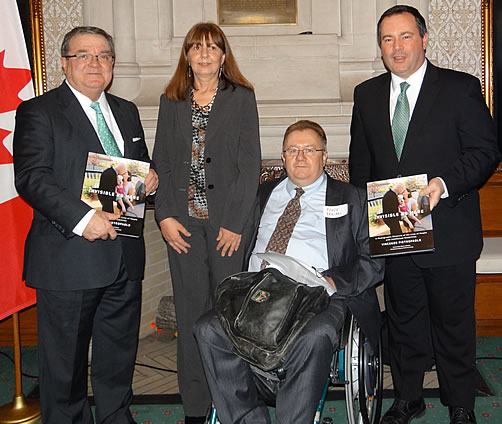
Minister Flaherty, Laurie Larson, CACL President, Tony Dolan, CCD Chairperson, and Minister Kenney at December 3rd Breakfast for disability community.
November 29, 2013
International Day of Persons with Disabilities December 3
Ministers Flaherty and Kenney will host a breakfast on Parliament Hill on December 3rd to provide an opportunity for Members of Parliament to meet with CCD volunteers and others who provide the leadership and direction to the disability movement in Canada. Read more.
June 3, 2013
ACCDs Campaign For Barrier Free Health and Medical Services in Alberta
ACCD has started an awareness campaign about the issues that people with disabilities experience when accessing health and medical services in Alberta. As a part of our awareness campaign, we prepared a four minutes video that explains in simple language the high importance of barrier-free health and medical services: http://www.youtube.com/watch?v=1iBosJzHZdM Read more.
February 12, 2013
Bill C - 400
I'm asking if you could take 15 minutes to contact your MP and urge their support of Bill C-400.~Tony Dolan, CCD Chairperson
December 3, 2012
We All Are People With Disabilities: You Are Us
“December 3rd, International Day of Persons with Disabilities, is a day to celebrate and highlight our achievements. Much has been achieved but much remains to be done. This year we ask all Canadians to reflect on the fact that disability is only an accident or a diagnosis away and that we all must work for and support efforts to make Canada more inclusive and accessible,” said Tony Dolan, CCD National Chairperson. Read more.
June 14, 2012
The Envelope Please: The Voting Results from CCD's AGM
Tony Dolan was returned to the office of Chairperson for a second term. Joining Tony on the Executive Committee are Pat Danforth, First Vice Chair; Steve Estey, Second Vice Chair; Marc Workman, Secretary; Anne McPhee, Treasurer; and Carmela Hutchison, Member-at-Large on the Executive. Read more.
June 14, 2012
Provincial and National Leaders on Disability Issues Recognized
Through the presentation of the CCD Awards, the Council of Canadians with Disabilities (CCD), a national organization working for a barrier-free Canada, recognizes the contributions of leaders in the disability community. At the CCD Annual General Meeting on 9 June 2012, Tony Dolan, CCD Chairperson, announced the recipients of this year’s CCD Awards. Read more.
June 5, 2012
Save the Date
Reserve 28 and 29 November 2012 on your calendar for End Exclusion. Read more.
March 14, 2012
Budget 2012
Following the Budget, Government MP’s will return to their constituencies from April 9th -20th to “sell” the budget and build support for its proposals. Opposition MP’s will present their criticisms of the government’s actions. This is an opportunity for us, Canadians with disabilities, to present our concerns to our Member of Parliament. Read more.
December 1, 2011
Celebrating Our Accomplishments on UN Day of Persons with Disabilities
On 3 December 2011, Canadians will be celebrating the United Nations’ Day of Persons with Disabilities. The history of advances in disability policy at the federal level is presented in a new book, called Celebrating Our Accomplishments, published last month by the Council of Canadians with Disabilities (CCD), a national organization of people with disabilities working for an inclusive and accessible Canada. Read more.
November 16, 2011
Use Election to Recommit to Access and Inclusion for Manitobans with Disabilities
Like many other disability organizations, the MLPD has endorsed the disability community’s National Action Plan and the more recent Call to Action. These documents call upon Governments in Canada to fulfill the commitments made to Canadians with disabilities when this country ratified the United Nations Convention on the Rights of Persons with Disabilities (CRPD). Read more.
May 4, 2011
Your Help Is Needed!
CCD encourages everyone to contact their MP to remind them about the National Action Plan. The National Action Plan presents our recommendations for ending disability poverty, getting people with disabilities employed and developing an inclusive and accessible Canada. Read more.
January 27, 2011
Disability is Not a Partisan Issue
Whether through personal experience or that of family members, all Canadians are, or will be, affected by disability. Disability is not a partisan issue; disability is everyone’s issue. In the disability community, there is consensus that the priority issues for immediate attention are: poverty alleviation, improved employment opportunities for people with disabilities, investments to improve access and inclusion and support to the voluntary sector. Read more.
January 25, 2011
Pre Budget Consultation Brief to The Standing Committee on Finance: Disability Is Not A Partisan Issue
CCD reminds all Members of Parliament that disability issues are not partisan issues. Our issues are of concern to all Canadians and most Canadians, at some point in their life, will access supports and services built to Create a More Accessible and Inclusive Canada. CCD is well aware that the federal jurisdiction has its limitations and that responsibility for many of our issues rests with the provinces and territories. CCD calls on the Government of Canada to work collaboratively with the provinces and territories on labour market strategies and broad social policy initiatives to address the needs of persons with disabilities. Wherever possible, CCD asks the Government of Canada to use its legislative powers to ensure that persons with disabilities are included fully in Canadian programs and services. Read more.
May 13, 2010
PALS and Data Collection on Persons with Disabilities
The Department is in the process of designing the new strategy for data collection on the status of persons with disabilities in Canada. PALS has been a very important tool for the disability community and frankly it is the only source of reliable data on persons with disabilities available to researchers, governments and the disability community. Only with good data can good programs be developed and implemented and only through ongoing data collection can we ascertain over the long-term whether programs are having positive impacts. HALS and PALS were developed over the years through supported consultation with our community. We urge you to ensure that the new strategy engages and seeks input from the broad community of persons with disabilities as well as from a technical committee of end users of that data. Read more.
May 10, 2010
Affordable Accessible Housing- A Critical Issue for Canadians with Disabilities
The Council of Canadians with Disabilities (CCD) urges all Parliamentarians to support Bill C-304 – An Act to ensure secure, adequate, accessible and affordable housing for Canadians. One of the major issues people with disabilities have is finding affordable and accessible housing. Read more.
February 19, 2010
Disability Community Needs PALS in 2011
CCD has been urging HRSDC to support PALS 2011. Community members committed to effective disability public policy may also want to write to the Hon. Diane Finley, Minister Human Resources and Skills Development Canada, and call for the Government of Canada to support PALS 2011 Read more.
January 13, 2010
A Call For Action
Members of Parliament will be spending more time in their constituency offices in January and February. NOW is the perfect time for us to ensure that they know the priorities of Canadians with disabilities.Call, write or meet with your Member of Parliament before the end of February.Tell them about our national priorities.
December 2, 2009
International Day of Persons with Disabilities (IDPD): Celebrating Yes! But What?
Canadians with disabilities know that change does not occur overnight but will not accept inaction or regression. It is time to use new tools and new knowledge to accelerate the achievement of a more Inclusive and Accessible Canada. Read more.
October 21, 2009
CCD Affidavit in the Hughes Case
Mr. Peter Hughes encountered barriers when he went to cast his ballot in a Canadian Federal election. As a result, he made a complaint to the Canadian Human Rights Commission regarding the inaccessibility of his local polling station. Elections Canada is responsible for access at polling stations in Federal elections. This case is to be heard by the Canadian Human Rights Tribunal. CCD submitted an affidavit seeking recognition as an interested party in the case. CCD has an in-depth understanding of the barriers experienced by persons with disability in the context of voting. In its affidavit, CCD shares its perspective on the fundamental importance of voting and the impact on people with disabilities when they experience barriers that prevent them from voting on an equal basis as people without disabilities. Understanding these barriers is critical for the Canadian Human Rights Tribunal in order to interpret the duty to accommodate and the factors to be considered in assessing undue hardship. Read more.
September 1, 2009
Pre Budget Consultation Brief Submission
In these challenging times, CCD urges the Government of Canada to remember those who already face significant disadvantage. Canadians with disabilities struggle when times are good to have their needs met. When times are bad, sadly we are often the first to feel the effects of cutbacks in services and supports or loss of employment.
January 6, 2009
Pre Budget Consultation with Minister Flaherty
In these challenging times, CCD urges you and your colleagues to ensure that those who already face significant disadvantage are not forgotten. Canadians with disabilities struggle when times are good to have their needs met and when times are bad sadly we are often the first to feel the effects of cutbacks or loss of employment. Read more.
August 29, 2008
Council of Canadians with Disabilities Submission to the Canada Post Corporation Strategic Review
CCD shares its views with the Canada Post Corporation Strategic Review (CPCSR), regarding how Canada's postal service should function. An accessible postal service free from systemic discrimination against persons with disabilities is a key component of an accessible and inclusive Canada. Read more.
June 1, 2008
Council of Canadians with Disabilities (CCD) Proposals Re: Expansion and Renewal of the Social Development Partnership Fund
CCD shares its views on renewal of the Social Development Partnership Program (SDPP). SDPP must be renewed and expanded. The first principle of any renewal is that no organization should be worse off. Read more.

End Exclusion supporters rally in support of an accessible and inclusive Canada.